espresso.compare

Breville vs De'Longhi

Brand comparison · 31 machines

Quick verdict

The two brands that dominate US home espresso, split by philosophy. Breville builds portafilter machines and publishes extraction pressure alongside pump pressure; De'Longhi covers both halves of the market, from a $150 manual machine to a $2,000 bean-to-cup, and publishes a complete attribute sheet for every US SKU.

Breville

Australia · founded 1932

Machines tracked
12
Published price range
$300–$2,000
Types made
Semi-automatic
With built-in grinder
7
Automatic milk
5
58 mm commercial group
3
PID temperature control
5
Highest scoring
Oracle Touch

De'Longhi

Italy · founded 1902

Machines tracked
19
Published price range
$150–$2,000
Types made
Semi-automatic, Super-automatic
With built-in grinder
15
Automatic milk
10
58 mm commercial group
0
PID temperature control
0
Highest scoring
Dedica Maestro Plus

Breville: warranty, parts and repairability

Breville publishes a limited product warranty on each US product page; terms vary by model and are stated at the point of sale.

Breville operates a US service network and sells first-party replacement parts and cleaning consumables directly.

Baskets, seals, water filters and cleaning tablets are stocked as first-party parts. The 54 mm portafilter used below the Dual Boiler is a Breville size, so third-party basket and tamper choice is narrower than for 58 mm machines.

De'Longhi: warranty, parts and repairability

De'Longhi publishes warranty terms per SKU on its US product pages and operates a US support centre with model-specific manuals.

De'Longhi runs a US support centre with downloadable manuals per SKU and sells first-party descaler, water filters and milk-system cleaner.

The automatic range uses a removable brew group that the owner rinses under the tap — the single biggest serviceability advantage over sealed super-autos. Descaler and AquaClean-style filters are stocked first-party.

Top Breville machines

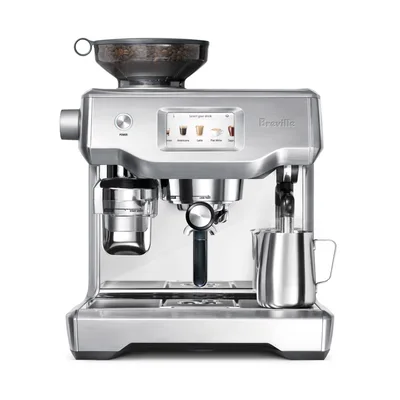
Breville Oracle Touch semi-auto espresso machine, front view
Semi-automatic

Discontinued, and the most automated dual-boiler 58 mm machine Breville has made — grinder, tamping and milk all handled.

  • Semi-automatic
  • Dual boiler
  • PID
  • Grinder · 45 settings
  • 58mm portafilter
  • Steam wand
Pump:15 bar(marketing)·Brews at:~9 bar(what the coffee actually sees)
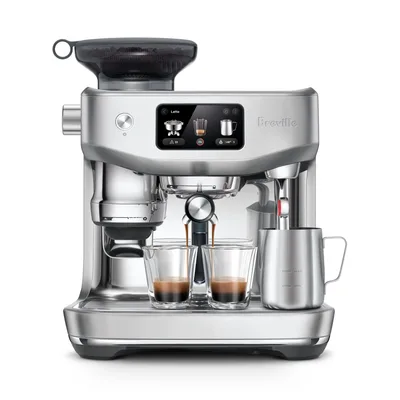
Breville Oracle Jet semi-auto espresso machine, front view
Semi-automatic

58 mm portafilter, 45 grind settings and Auto MilQ automatic texturing with alternative-milk profiles in one touchscreen machine.

  • Semi-automatic
  • Grinder · 45 settings
  • 58mm portafilter
  • Steam wand
Pump pressure: — (not published by the manufacturer) · espresso extracts at ~9 bar regardless.
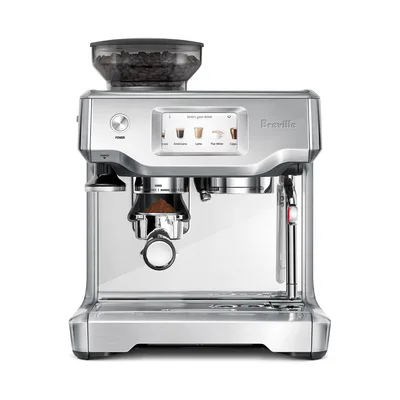
Breville Barista Touch semi-auto espresso machine, front view
Semi-automatic

Grinder, ThermoJet and Auto MilQ automatic texturing behind a touchscreen — the least manual machine that still uses a portafilter.

  • Semi-automatic
  • ThermoJet
  • Grinder · 30 settings
  • 54mm portafilter
  • 3s heat-up
  • Steam wand
Pump:15 bar(marketing)·Brews at:~9 bar(what the coffee actually sees)
Top De'Longhi machines

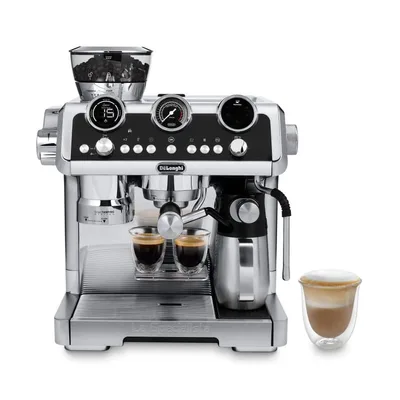
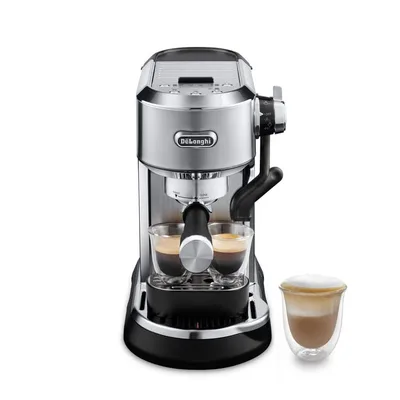
Dedica Maestro Plus Espresso Machine with Automatic Steam Wand — semi-auto espresso machine, front view
Semi-automatic

A Dedica with an automatic steam wand — milk texturing without the learning curve, still in a compact body.

  • Semi-automatic
  • Steam wand
Pump:15 bar(marketing)·Brews at:~9 bar(what the coffee actually sees)
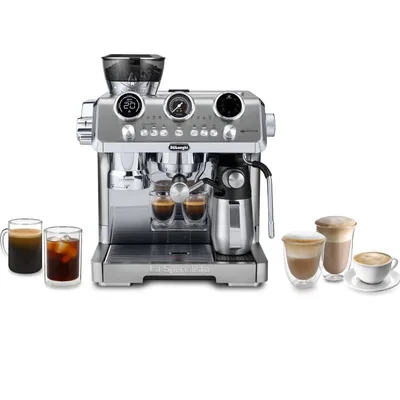
La Specialista Maestro — semi-auto espresso machine, front view
Semi-automatic

Two independent heating systems so brewing and steaming do not queue behind each other, with a twin-sensor grinder.

  • Semi-automatic
  • Thermoblock
  • Grinder · 8 settings
  • Steam wand
Pump pressure: — (not published by the manufacturer) · espresso extracts at ~9 bar regardless.

Frequently asked

Is Breville or De'Longhi better?
The two brands that dominate US home espresso, split by philosophy. Breville builds portafilter machines and publishes extraction pressure alongside pump pressure; De'Longhi covers both halves of the market, from a $150 manual machine to a $2,000 bean-to-cup, and publishes a complete attribute sheet for every US SKU.
Which brand has more machines with a built-in grinder?
Breville has 7 of 12 in our database; De'Longhi has 15 of 19.
Which is easier to get parts for?
Breville: Baskets, seals, water filters and cleaning tablets are stocked as first-party parts. The 54 mm portafilter used below the Dual Boiler is a Breville size, so third-party basket and tamper choice is narrower than for 58 mm machines. De'Longhi: The automatic range uses a removable brew group that the owner rinses under the tap — the single biggest serviceability advantage over sealed super-autos. Descaler and AquaClean-style filters are stocked first-party.