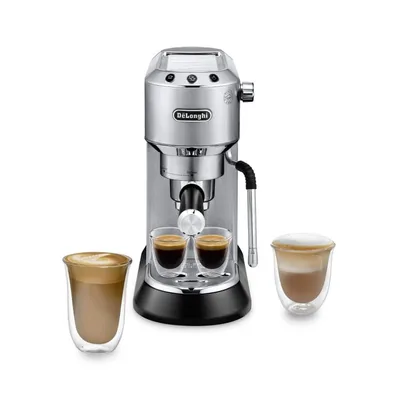
46/100
Semi-automatic
The same 5.9-inch-wide body as the Dedica Deluxe, with a manual steam wand instead of an assisted frother.
- Semi-automatic
- Steam wand
Pump:15 bar(marketing)·Brews at:~9 bar(what the coffee actually sees)
Updated · Semi-automatic
To learn milk texturing on a real steam wand, $250.
Computed from published specifications — not a taste test. We do not brew or physically test machines.
Prices are the manufacturer's published list price plus any snapshots we have tracked; confirm on the retailer's page before buying. As an Amazon Associate we earn from qualifying purchases — this never affects rankings, which are computed from specifications.
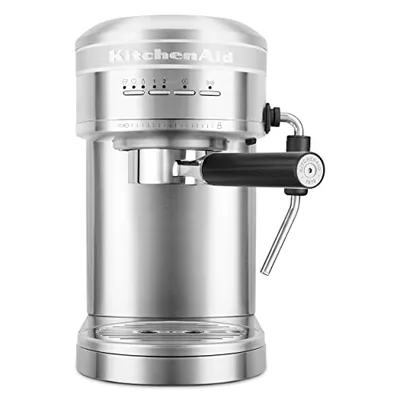
The honest read: the KitchenAid KES6503 Metal Semi-Automatic Espresso Machine suits you if you already own a burr grinder, or have budgeted for one alongside this machine, and if you are willing to spend a few weeks learning to texture milk on a real wand.
It is the wrong machine if the grinder is not in the budget — this machine cannot reach its ceiling on pre-ground coffee, or if KitchenAid rates it for one or two drinks a day, so a busy household will find it limiting. None of that is a defect — it is what KitchenAid chose to build, and choosing against it is how you avoid an expensive mismatch.
Underneath the specifications sits a simpler question: how many minutes do you want to spend? Four or five minutes plus whatever your separate grinder adds, and a genuine learning period before that becomes reliable. Answer that for the mornings you actually have rather than the ones you imagine, because that is the gap most unused machines fall into.
KitchenAid does not publish a pump pressure figure for this model, and it costs you nothing. The bar rating quoted elsewhere in the category describes a pump's maximum output rather than the roughly 9 bar at which espresso actually extracts.
The specifications worth reading on this machine are the heating system, whether temperature is held by a PID or a thermostat, and the portafilter standard — all of which change what the machine can do, where the bar number does not.
The thermocoil arrangement trades stored heat for speed: almost nothing to warm up, and correspondingly little mass to stabilise the temperature mid-shot.
KitchenAid does not state whether temperature is PID-controlled.
Because the baskets are single-wall, nothing but the puck stands between the pump and the cup. Get the grind wrong and the shot tells you immediately, which is exactly the feedback a pressurized basket removes.
The limiting component here is not on this spec sheet. Pre-ground coffee is fixed at one fineness chosen for somebody else's equipment, so a separate burr grinder is a requirement rather than an upgrade path.
A bare steam wand puts the air and the texture in your hands. Introduce air for two or three seconds, then submerge the tip and let the milk roll — that second phase is what breaks the bubbles down into microfoam.
The ceiling matters more than the floor. Milk held past about 160°F loses its sweetness and its structure permanently, so the skill is knowing when to stop rather than how long to go.
KitchenAid does not publish full dimensions for this model, so measure against the product photograph with care.
No manufacturer in this category publishes a decibel rating, so we make no noise claim. Structurally, the pump runs for the length of a shot, and a vibratory pump buzzes audibly while it runs.
There is no three-way valve, so this machine cannot be backflushed. Cleaning the brew path means removing and soaking the shower screen and scrubbing the group instead.
The steam wand wants five seconds of attention the moment you finish: a purge to clear what was drawn back up, and a wipe. Left until later, milk sets hard in holes too small to clear easily.
Descaling is on its own schedule — every one to three months depending on your water hardness, using KitchenAid's approved solution rather than vinegar. Machines with narrow thermoblock passages are the least tolerant of a missed interval, because scale narrows the channel until it blocks.
Neglect announces itself in two disguises. A bitter, stale note that follows you across different bags is almost always oils in the group rather than the beans. A shot that has crept slower over months at the same setting is almost always scale rather than the grinder. Detergent fixes the first, an acid descaler the second.
The group gasket is the one part that will certainly need replacing. When the handle starts creeping past its usual position, the rubber has hardened and stopped sealing — which is also the most common cause of water escaping around the portafilter.
The KF bean-to-cup series uses a removable bean hopper with an automatic purge cycle and supplies brew-unit cleaning tablets. Semi-automatic models ship with both single-wall and pressurized baskets, so the portafilter can be used either way.
At $250 the machine is the smaller half of the first year. Beans at roughly $260, descaler and filters at about $70, with electricity unknown because no wattage is published bring the first year to roughly $580.
For context, the median published price across machines of this type in our database is $600, so this sits below the middle of its category. A burr grinder is an additional purchase on top.
The KitchenAid KES6503 Metal Semi-Automatic Espresso Machine is a coherent machine with one main compromise: that it arrives without the grinder that determines most of what it can do. Whether that matters is a question about you rather than about the machine.
If it is a problem, the Breville Bambino ($300) is the alternative worth reading next.
Read the score as what it is: a percentile against machines of the same kind, computed from published specifications. It measures specification potential rather than cup quality, and a machine can score modestly against its cohort while being exactly right for one buyer.
Everything above is derived from KitchenAid's published specification and our scoring methodology. We have not brewed with this machine and make no claim about how it tastes.
Chosen from this machine's own specification — not a generic bundle. The KitchenAid KES6503 Metal Semi-Automatic Espresso Machine needs these because of what it does and does not include.
Not optional — pre-ground coffee cannot be adjusted to the fineness espresso needs.
Scale, not use, is what ends most espresso machines. Use the manufacturer-approved solution, never vinegar.
350 ml for one drink, 600 ml for two — too large a jug prevents the vortex that makes microfoam.
As an Amazon Associate we earn from qualifying purchases. These are category searches rather than specific product endorsements — we have not tested accessories any more than we have tested machines.
Transcribed from KitchenAid's official spec sheet. An em dash means the manufacturer does not publish that figure — we never estimate one in.
| Spec | Value |
|---|---|
| Machine type | Semi-automatic |
| Automation level | Semi-automatic |
| Status | Current model |
| Release year | — |
| Suggested daily volume | 1-2 drinks/day |
| Spec | Value |
|---|---|
| Heating system | Thermocoil |
| Heating circuits | 1 |
| Boiler material | — |
| PID temperature control | — |
| Heat-up time | — |
| Pump pressure (marketing) | — |
| Brew pressure at the puck | ~9 bar — the figure that matters |
| Pump type | — |
| Pressure profiling | — |
| Spec | Value |
|---|---|
| Built-in grinder | No |
| Burr type | — |
| Grind settings | — |
| Bean hopper | — |
| Spec | Value |
|---|---|
| Portafilter size | — |
| Portafilter type | Non-pressurized |
| Group type | — |
| Milk system | Steam wand |
| Automatic milk texturing | No |
| Spec | Value |
|---|---|
| Water tank | — |
| Dimensions | — |
| Width | — |
| Weight | — |
| Voltage | — |
| Wattage | — |
| Plumbable | No |
| Made in | — |
| Spec | Value |
|---|---|
| Descaling required | Yes |
| Automatic rinse / self-clean | — |
| Removable brew group | — |
| Backflushable (3-way valve) | No |
Consumables are estimates for roughly two drinks a day; electricity is computed from the manufacturer's published wattage. Full two-year calculator · how we calculate this
Percentile-ranked against other compact semi-automatic machines — machines bought for the same reasons, not every machine of the same type. A component with no published inputs is dropped, not scored zero.
Same machine type, similar price, ordered by score.
The same 5.9-inch-wide body as the Dedica Deluxe, with a manual steam wand instead of an assisted frother.
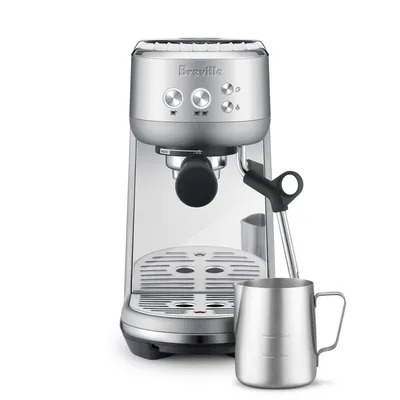
The smallest serious 54 mm machine Breville sells — three-second heat-up, no grinder, no compromise on the shot.
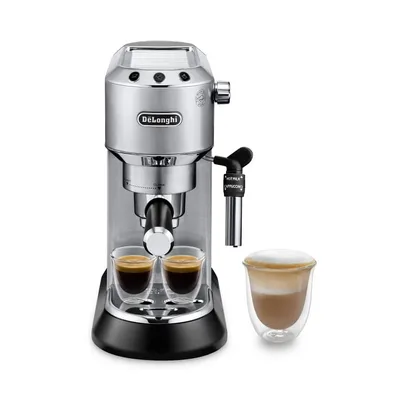
Under six inches wide — the machine to buy when counter width, not budget, is the binding constraint.
Position on each list this machine qualifies for. Each list ranks its own members, so these placings say more than any single score does.
We publish KitchenAid's error codes and display messages transcribed from KitchenAid's own manuals, with what each one means and the user-serviceable fix.
Every specification on this page was transcribed from KitchenAid's official product page for the KitchenAid KES6503 Metal Semi-Automatic Espresso Machine. Figures the manufacturer does not publish are stored as null and rendered as an em dash. Scores are computed by our published methodology and are not a taste test.