espresso.compare

Breville Barista Express Impress Specs, Score & Price (2026)

Updated · Semi-automatic

Quick answer

A grinder and PID temperature control in a single box, 16.6 in wide, $800.

Best for
beginners who struggle with tamping
Not for
You already own a decent burr grinder the Gaggia Anima Prestige ($849)
Also budget
Standing
#5 of 18 in The Best Espresso Machines Under $1,000 · 53/100 among all in one semi-automatic machines

Computed from published specifications — not a taste test. We do not brew or physically test machines.

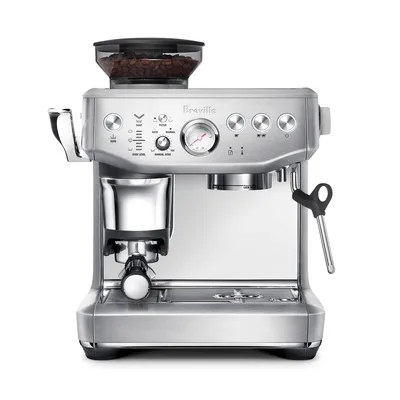
Breville Barista Express Impress semi-auto espresso machine, front view
Price
$800
Manufacturer (MSRP) · checked August 3, 2026
Lowest we've tracked
Amazon
check current price
Amazon
$800

Prices are the manufacturer's published list price plus any snapshots we have tracked; confirm on the retailer's page before buying. As an Amazon Associate we earn from qualifying purchases — this never affects rankings, which are computed from specifications.

Pressure reality

Pump:15 bar(marketing)·Brews at:~9 bar(what the coffee actually sees)

The bar number on the box is the pump's maximum, not the brewing pressure. An over-pressure valve regulates it down to roughly 9 bar at the puck. Why the box number doesn't matter →

Is the Breville Barista Express Impress right for you?

Put plainly: the Breville Barista Express Impress suits you if you want to learn espresso without buying and housing a second appliance, and if you are willing to spend a few weeks learning to texture milk on a real wand.

It is the wrong machine if you already own a burr grinder you rate, in which case you are paying twice for one. None of that is a defect — it is what Breville chose to build, and choosing against it is how you avoid an expensive mismatch.

Everything else follows from how much of your morning this should occupy. Four or five minutes from cold once you know the machine: grind, dose, tamp, pull, texture, wipe down. Buyers who answer that honestly stay happy with modest machines; buyers who answer aspirationally end up with capable ones gathering dust.

"15 bar", decoded

15 bar is the number printed largest on the box, and it is the least useful specification on the machine. It describes the maximum pressure the pump can generate against a closed outlet.

Espresso extracts at roughly 9 bar at the coffee. Every well-designed machine, including this one, regulates the pump down to about that using an over-pressure valve that bleeds the excess back to the tank. A machine advertising 15 bar and one advertising 9 bar can pull an identical shot — and a machine that genuinely delivered 15 bar to the puck would make worse espresso, because excessive pressure compacts the bed and promotes channelling.

The specification that does change what this machine can do is the 54 mm portafilter, Breville's own size — first-party baskets and tampers are plentiful, third-party choice is narrower than for the 58 mm commercial standard.

We publish both numbers on every machine for this reason. The bar rating is what the manufacturer chose to advertise; ~9 bar is what the coffee experiences.

Espresso quality: boiler, temperature, pressure

The thermocoil arrangement trades stored heat for speed: almost nothing to warm up, and correspondingly little mass to stabilise the temperature mid-shot.

A PID replaces the on-off thermostat with continuous correction, so the temperature you choose is the temperature the water arrives at rather than an average it oscillates around.

Because the baskets are single-wall, nothing but the puck stands between the pump and the cup. Get the grind wrong and the shot tells you immediately, which is exactly the feedback a pressurized basket removes.

Grind is adjusted across 25 settings. Dialling in means making small corrections inside a narrow band, so the number of usable steps matters more than the headline count — with 25 you have room to move without landing between two settings, one too fast and one too slow.

Milk: what a steam wand means

A bare steam wand puts the air and the texture in your hands. Introduce air for two or three seconds, then submerge the tip and let the milk roll — that second phase is what breaks the bubbles down into microfoam.

The ceiling matters more than the floor. Milk held past about 160°F loses its sweetness and its structure permanently, so the skill is knowing when to stop rather than how long to go.

Living with it

It measures 16.6 in wide, 14.4 in deep, 12.2 in tall.

No manufacturer in this category publishes a decibel rating, so we make no noise claim. Structurally, the pump runs for the length of a shot and the grinder for a few seconds before it, and a vibratory pump buzzes audibly while it runs.

Cleaning, descaling and the weekly routine

There is no three-way valve, so this machine cannot be backflushed. Cleaning the brew path means removing and soaking the shower screen and scrubbing the group instead.

Wipe and purge the wand every time rather than at the end of a session — a blocked tip is the single most common steam fault and it is entirely preventable.

Descaling is on its own schedule — every one to three months depending on your water hardness, using Breville's approved solution rather than vinegar. Machines with narrow thermoblock passages are the least tolerant of a missed interval, because scale narrows the channel until it blocks.

Two residues accumulate and they need opposite chemistry. Coffee oil builds wherever coffee flows and turns rancid; mineral scale builds wherever water is heated and narrows the path. Using a descaler on an oil problem, or a detergent on a scale problem, accomplishes nothing at all.

Repairability and parts

The 54 mm group is Breville's own size, so wear parts come from their catalogue rather than the commercial parts ecosystem.

The group gasket is the one part that will certainly need replacing. When the handle starts creeping past its usual position, the rubber has hardened and stopped sealing — which is also the most common cause of water escaping around the portafilter.

Baskets, seals, water filters and cleaning tablets are stocked as first-party parts. The 54 mm portafilter used below the Dual Boiler is a Breville size, so third-party basket and tamper choice is narrower than for 58 mm machines.

What it costs to own

At $800 the machine is the smaller half of the first year. Beans at roughly $260, descaler and filters at about $70, with electricity unknown because no wattage is published bring the first year to roughly $1,130.

For context, the median published price across machines of this type in our database is $600, so this sits above the middle of its category.

The verdict

The Breville Barista Express Impress is a coherent machine with one main compromise: price rather than capability. Whether that matters is a question about you rather than about the machine.

If it is a problem, the Gaggia Anima Prestige ($849) is the alternative worth reading next.

Read the score as what it is: a percentile against machines of the same kind, computed from published specifications. It measures specification potential rather than cup quality, and a machine can score modestly against its cohort while being exactly right for one buyer.

Everything above is derived from Breville's published specification and our scoring methodology. We have not brewed with this machine and make no claim about how it tastes.

What you'll need with it

Chosen from this machine's own specification — not a generic bundle. The Breville Barista Express Impress needs these because of what it does and does not include.

As an Amazon Associate we earn from qualifying purchases. These are category searches rather than specific product endorsements — we have not tested accessories any more than we have tested machines.

Full specification

Transcribed from Breville's official spec sheet. An em dash means the manufacturer does not publish that figure — we never estimate one in.

Type & automation

SpecValue
Machine typeSemi-automatic
Automation levelSemi-automatic
StatusCurrent model
Release year
Suggested daily volume2-5 drinks/day

Boiler & pressure

SpecValue
Heating systemThermocoil
Heating circuits1
Boiler material
PID temperature controlYes
Heat-up time
Pump pressure (marketing)15 bar
Brew pressure at the puck~9 bar — the figure that matters
Pump type
Pressure profiling

Grinder

SpecValue
Built-in grinderYes
Burr typeconical burr
Grind settings25
Bean hopper

Portafilter & milk

SpecValue
Portafilter size54 mm
Portafilter typeNon-pressurized
Group typeproprietary
Milk systemSteam wand
Automatic milk texturingNo

Capacity & build

SpecValue
Water tank
Dimensions16.6 × 14.4 × 12.2 in (W×D×H)
Width16.6 in
Weight
Voltage
Wattage
PlumbableNo
Made in

Maintenance

SpecValue
Descaling requiredYes
Automatic rinse / self-clean
Removable brew group
Backflushable (3-way valve)No

Pros

  • PID temperature control holds brew temperature shot to shot
  • Grinder built in with 25 settings, so there is no second appliance to buy
  • A real steam wand rather than an assisted frother, so microfoam is achievable

Cons

  • 54 mm portafilter limits third-party basket and tamper choice compared with 58 mm
  • Not backflushable — group cleaning is limited to wiping and soaking the basket
True 1-year cost
~$1,130
  • Machine $800
  • Beans ~$260 (about 1 lb a fortnight)
  • Descaler ~$30 · Water filters ~$40
  • Electricity — (wattage not published)

Consumables are estimates for roughly two drinks a day; electricity is computed from the manufacturer's published wattage. Full two-year calculator · how we calculate this

Score breakdown
  • Espresso potential73/100
  • Milk31/100
  • Build36/100
  • Maintenance46/100
  • Ease of use23/100
  • Value85/100

Percentile-ranked against other all in one semi-automatic machines — machines bought for the same reasons, not every machine of the same type. A component with no published inputs is dropped, not scored zero.

Add up to three machines, then compare side by side.

Alternatives to consider

Same machine type, similar price, ordered by score.

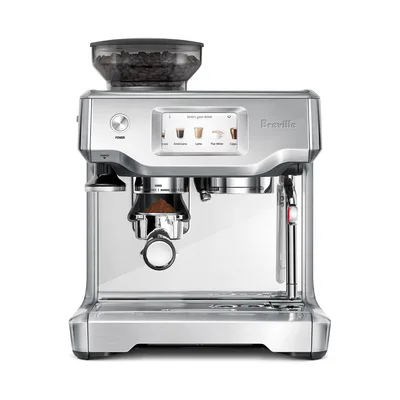
Breville Barista Touch semi-auto espresso machine, front view
Semi-automatic

Grinder, ThermoJet and Auto MilQ automatic texturing behind a touchscreen — the least manual machine that still uses a portafilter.

  • Semi-automatic
  • ThermoJet
  • Grinder · 30 settings
  • 54mm portafilter
  • 3s heat-up
  • Steam wand
Pump:15 bar(marketing)·Brews at:~9 bar(what the coffee actually sees)
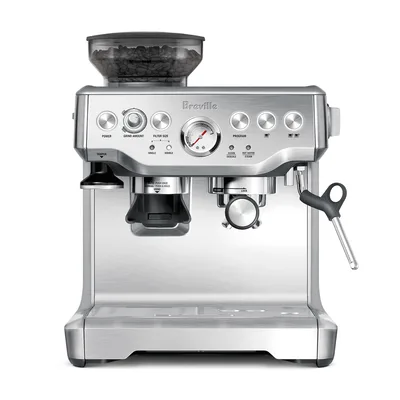
Breville Barista Express semi-auto espresso machine, front view
Semi-automatic

The default first espresso machine in the US: PID-controlled thermocoil, integrated conical burr grinder, 16 grind settings, one footprint.

  • Semi-automatic
  • Thermocoil
  • PID
  • Grinder · 16 settings
  • 54mm portafilter
  • Steam wand
Pump:15 bar(marketing)·Brews at:~9 bar(what the coffee actually sees)
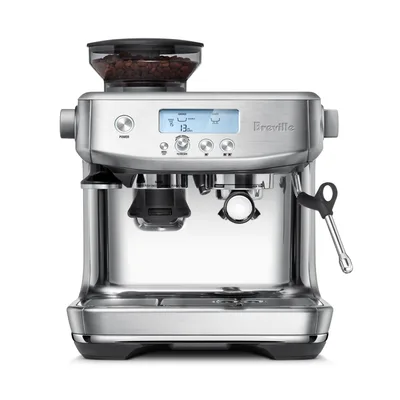
Breville Barista Pro semi-auto espresso machine, front view
Semi-automatic

The Barista Express with ThermoJet instead of a thermocoil — three seconds to extraction temperature and 30 grind settings.

  • Semi-automatic
  • ThermoJet
  • Grinder · 30 settings
  • 54mm portafilter
  • 3s heat-up
  • Steam wand
Pump:15 bar(marketing)·Brews at:~9 bar(what the coffee actually sees)

Frequently asked

Is the 15 bar pump on the Breville Barista Express Impress better than a 9 bar machine?
No. 15 bar is the pump's maximum output, not the pressure at the coffee. Espresso extracts at about 9 bar, and an over-pressure valve regulates the pump down to roughly that. A machine advertising 15 bar and one advertising 9 bar can pull an identical shot.
Does the Breville Barista Express Impress come with a grinder?
Yes, a conical burr grinder is built in with 25 grind settings. You do not need a separate grinder, though a standalone grinder at similar money would generally offer more adjustment.
Can the Breville Barista Express Impress make a latte or cappuccino?
Yes. It uses steam wand, which you operate yourself — the technique takes practice but gives full control over texture.
Do you need to descale the Breville Barista Express Impress?
Yes. Descale every one to three months depending on your water hardness, using the manufacturer's descaling solution. Scale, not use, is what ends most espresso machines.
What size portafilter does the Breville Barista Express Impress use?
54 mm. First-party baskets and accessories are readily available, but third-party choice is narrower than for the 58 mm commercial standard.
What does the Breville Barista Express Impress cost to run?
Beyond the $800 purchase, budget roughly $260 a year for beans at two drinks a day, about $70 for descaler and filters, and electricity computed from the machine's published wattage. Consumables typically cost more over two years than the machine did.
Compared against

Published side-by-side comparisons involving this machine.

Where this machine ranks

Position on each list this machine qualifies for. Each list ranks its own members, so these placings say more than any single score does.

If this machine shows a code

We publish Breville's error codes and display messages transcribed from Breville's own manuals, with what each one means and the user-serviceable fix.

Breville error codes →

Sources

Every specification on this page was transcribed from Breville's official product page for the Breville Barista Express Impress. Figures the manufacturer does not publish are stored as null and rendered as an em dash. Scores are computed by our published methodology and are not a taste test.