espresso.compare

De'Longhi Dinamica Specs, Score & Price (2026)

Updated · Super-automatic

Quick answer

Grinding and brewing handled for you, milk by hand, 9.3 in wide.

Best for
iced coffee as well as espresso
Not for
You want to control the dose, grind or extraction yourself the Breville Bambino Plus ($500)
Also budget
Standing
#28 of 37 in The Best Espresso Machines for Apartments · 27/100 among super-automatic machines

Computed from published specifications — not a taste test. We do not brew or physically test machines.

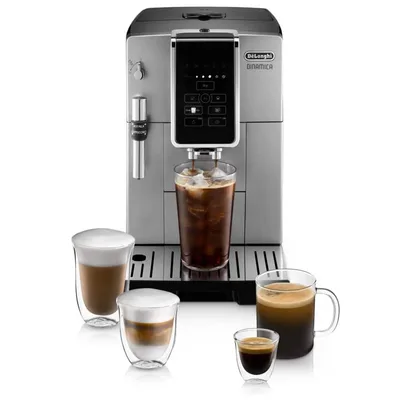
Dinamica Automatic Coffee & Espresso Machine with Iced Coffee + Adjustable Milk Frother, Silver - ECAM35025SB — bean-to-cup espresso machine, front view
Price
$900
Whole Latte Love · checked July 30, 2026
Lowest we've tracked-33% vs 90-day average
Amazon
check current price
Amazon
$1,448

Prices are the manufacturer's published list price plus any snapshots we have tracked; confirm on the retailer's page before buying. As an Amazon Associate we earn from qualifying purchases — this never affects rankings, which are computed from specifications.

Pressure reality

Pressure managed automatically — brewing pressure is internal and not user-adjustable (pump rated 15 bar).

Is the De'Longhi Dinamica right for you?

Put plainly: the De'Longhi Dinamica suits you if you want a finished drink at one button and are happy for the machine to make every decision, and if counter width is tight — it needs 9.3 inches.

It is the wrong machine if you want to change the dose, the grind or how the shot extracts. None of that is a defect — it is what De'Longhi chose to build, and choosing against it is how you avoid an expensive mismatch.

The question underneath all of this is how long you want the process to take. A minute or so, most of which is the machine working while you do something else. That is the difference people actually live with, and it is worth answering honestly rather than aspirationally — a machine bought for the person you intend to become tends to go unused by the person making coffee on a Tuesday.

"One touch", decoded

The headline on every bean-to-cup machine is one-touch convenience, and it is true as far as it goes: the De'Longhi Dinamica grinds, doses, tamps, brews and ejects the puck without you seeing any of it.

What "one touch" does not mean is that the machine is doing what a barista does. Dose, grind fineness and extraction are decided internally and are not independently adjustable, so the ceiling is set by De'Longhi rather than by your technique. That is the whole trade: you cannot make it worse, and you cannot make it better.

The 15 bar figure on the box is the pump's maximum, not the brewing pressure. Espresso extracts at roughly 9 bar whatever the pump is rated at, and on a bean-to-cup machine the regulation is internal and not user-adjustable — which is why we describe pressure here as managed rather than quoting a number that implies a choice you do not have.

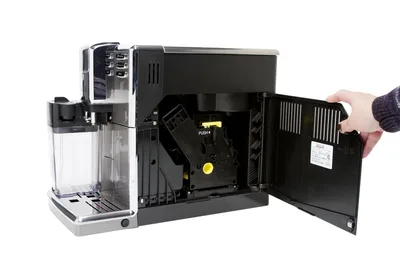
The specification that will matter most in three years is not on the box at all: the brew group lifts out for rinsing under the tap. Sealed brew groups turn routine cleaning into a service appointment, and this one does not.

Espresso quality: boiler, temperature, pressure

Rather than keeping a vessel at temperature, a thermoblock heats water as it passes through. Fast to start, and more dependent on flow rate to hold a steady temperature.

De'Longhi does not state whether temperature is PID-controlled.

Grind is adjusted across 13 settings. Dialling in means making small corrections inside a narrow band, so the number of usable steps matters more than the headline count — with 13 you have room to move without landing between two settings, one too fast and one too slow.

Milk: what an automatic frother means

Milk is handled by automatic frother.

Whatever the hardware, the target is the same: stop between 140 and 150°F. Past roughly 160°F the proteins denature, the sweetness goes and the foam collapses — and milk cannot be re-textured once taken there.

Living with it

It measures 9.3 in wide, 16.9 in deep, 13.7 in tall, which is narrow enough for most apartment counters.

The 1.8 litre tank is roughly 9 drinks between refills at typical volumes.

Noise goes unrated here for lack of any published measurement. The mechanical facts: the pump is vibratory, audible for the length of the extraction, with the grinder briefly louder still.

Electrically it is 120V, 1250 W — a standard US outlet, though it is worth not sharing a circuit with a kettle or toaster you use at the same moment.

Cleaning, descaling and the weekly routine

The weekly job is the brew group: it lifts out and rinses under warm water, no detergent, and goes back once dry. That is the single most important routine on a bean-to-cup machine and the reason removable groups outlast sealed ones.

Clean the wand while it is still hot. A quick purge and wipe takes seconds; a tip that has dried takes a soak and a pin.

Descaling is on its own schedule — every one to three months depending on your water hardness, using De'Longhi's approved solution rather than vinegar. Machines with narrow thermoblock passages are the least tolerant of a missed interval, because scale narrows the channel until it blocks.

Neglect announces itself in two disguises. A bitter, stale note that follows you across different bags is almost always oils in the group rather than the beans. A shot that has crept slower over months at the same setting is almost always scale rather than the grinder. Detergent fixes the first, an acid descaler the second.

Repairability and parts

The automatic range uses a removable brew group that the owner rinses under the tap — the single biggest serviceability advantage over sealed super-autos. Descaler and AquaClean-style filters are stocked first-party.

What it costs to own

There is no manufacturer-published US list price for this model, so we do not compute a total cost of ownership — the purchase price is the largest term, and estimating it would make every other number decorative.

What can be said is where the money goes afterwards — coffee first by a wide margin, then maintenance consumables and a small electricity line.

The verdict

The De'Longhi Dinamica is a coherent machine with one main compromise: that nothing about the extraction is adjustable. Whether that matters is a question about you rather than about the machine.

If it is a problem, the Breville Bambino Plus ($500) is the alternative worth reading next.

Scores here are relative and computed, never awarded. A modest figure against a cohort of far more expensive machines is a statement about the cohort as much as about this machine.

Everything above is derived from De'Longhi's published specification and our scoring methodology. We have not brewed with this machine and make no claim about how it tastes.

What you'll need with it

Chosen from this machine's own specification — not a generic bundle. The De'Longhi Dinamica needs these because of what it does and does not include.

As an Amazon Associate we earn from qualifying purchases. These are category searches rather than specific product endorsements — we have not tested accessories any more than we have tested machines.

Full specification

Transcribed from De'Longhi's official spec sheet. An em dash means the manufacturer does not publish that figure — we never estimate one in.

Type & automation

SpecValue
Machine typeSuper-automatic
Automation levelSuper-automatic
StatusCurrent model
Release year
Suggested daily volume2-5 drinks/day

Boiler & pressure

SpecValue
Heating systemThermoblock
Heating circuits1
Boiler material
PID temperature control
Heat-up time
Pump pressure (marketing)15 bar
Brew pressure at the puck~9 bar — the figure that matters
Pump type
Pressure profiling

Grinder

SpecValue
Built-in grinderYes
Burr typeconical burr
Grind settings13
Bean hopper

Portafilter & milk

SpecValue
Portafilter size
Portafilter type
Group type
Milk systemAutomatic frother
Automatic milk texturingNo

Capacity & build

SpecValue
Water tank1.8 L
Dimensions9.3 × 16.9 × 13.7 in (W×D×H)
Width9.3 in
Weight26 lb (11.7 kg)
Voltage120V
Wattage1250 W
PlumbableNo
Made in

Maintenance

SpecValue
Descaling requiredYes
Automatic rinse / self-cleanYes
Removable brew groupYes
Backflushable (3-way valve)No

Pros

  • Grinder built in with 13 settings, so there is no second appliance to buy
  • Brew group lifts out for rinsing under the tap, the key serviceability feature on a bean-to-cup machine
  • Narrow footprint at 9.3 in wide

Cons

  • No portafilter, so dose, grind and extraction cannot be adjusted independently — the ceiling is set by the machine, not by you
  • No manufacturer-published US list price, so true cost cannot be computed without guessing
True 1-year cost
~$1,277
  • Machine $900
  • Beans ~$260 (about 1 lb a fortnight)
  • Descaler ~$30 · Water filters ~$40
  • Electricity ~$47

Consumables are estimates for roughly two drinks a day; electricity is computed from the manufacturer's published wattage. Full two-year calculator · how we calculate this

Score breakdown
  • Espresso potential12/100
  • Milk22/100
  • Build20/100
  • Maintenance70/100
  • Ease of use50/100
  • Value

Percentile-ranked against other super-automatic machines — machines bought for the same reasons, not every machine of the same type. A component with no published inputs is dropped, not scored zero.

Add up to three machines, then compare side by side.

Alternatives to consider

Same machine type, similar price, ordered by score.

Gaggia Anima Prestige bean-to-cup espresso machine, front view
Super-automatic

Ceramic flat burrs and an integrated 0.5 litre milk carafe that froths automatically, in Gaggia's smallest super-auto body.

  • Super-automatic
  • Grinder · 5 settings
  • Automatic milk carafe
  • Removable brew group
Pressure managed automatically — brewing pressure is internal and not user-adjustable.
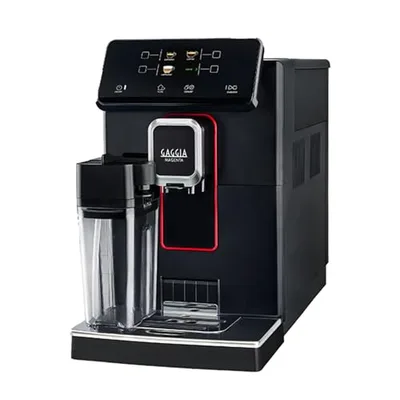
Gaggia Magenta Prestige bean-to-cup espresso machine, front view
Super-automatic

Under nine inches wide and 17 lb, with the same automatic 0.5 litre milk carafe as the rest of the Prestige line.

  • Super-automatic
  • Grinder · 5 settings
  • Automatic milk carafe
  • Removable brew group
Pressure managed automatically — brewing pressure is internal and not user-adjustable.
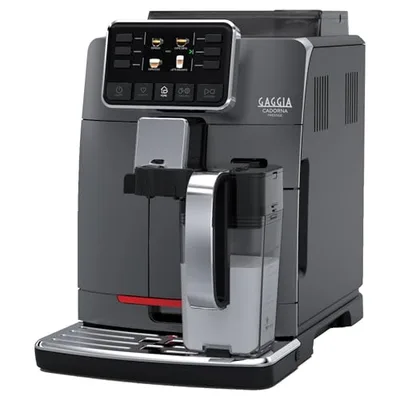
Gaggia Cadorna Prestige bean-to-cup espresso machine, front view
Super-automatic

Ten grind settings — twice the Magenta's — a 300 g hopper and an automatic milk carafe, made in Italy.

  • Super-automatic
  • Grinder · 10 settings
  • Automatic milk carafe
  • Removable brew group
Pressure managed automatically — brewing pressure is internal and not user-adjustable.

Frequently asked

What pressure does the De'Longhi Dinamica brew at?
Brewing pressure on a bean-to-cup machine is managed internally and is not user-adjustable; the pump is rated at 15 bar. As with every espresso machine, extraction happens at roughly 9 bar at the coffee — the pump rating is a maximum, not the brewing pressure.
Does the De'Longhi Dinamica come with a grinder?
Yes, a conical burr grinder is built in with 13 grind settings. You do not need a separate grinder, though a standalone grinder at similar money would generally offer more adjustment.
Can the De'Longhi Dinamica make a latte or cappuccino?
Yes. It uses automatic frother, which you operate yourself — the technique takes practice but gives full control over texture.
Do you need to descale the De'Longhi Dinamica?
Yes. Descale every one to three months depending on your water hardness, using the manufacturer's descaling solution. The brew group also lifts out for rinsing under the tap, which handles the coffee side of cleaning. Scale, not use, is what ends most espresso machines.
How big is the water tank on the De'Longhi Dinamica?
1.8 litres, which covers a typical day for most households.
How long will the De'Longhi Dinamica last?
Materials and descaling discipline decide this far more than price. Machines with brass or stainless boilers and standard commercial group hardware are routinely kept running for over a decade because the wear parts are replaceable; scale, not use, is what ends most machines.
Where this machine ranks

Position on each list this machine qualifies for. Each list ranks its own members, so these placings say more than any single score does.

If this machine shows a code

We publish De'Longhi's error codes and display messages transcribed from De'Longhi's own manuals, with what each one means and the user-serviceable fix.

De'Longhi error codes →

Sources

Every specification on this page was transcribed from De'Longhi's official product page for the De'Longhi Dinamica. Figures the manufacturer does not publish are stored as null and rendered as an em dash. Scores are computed by our published methodology and are not a taste test.