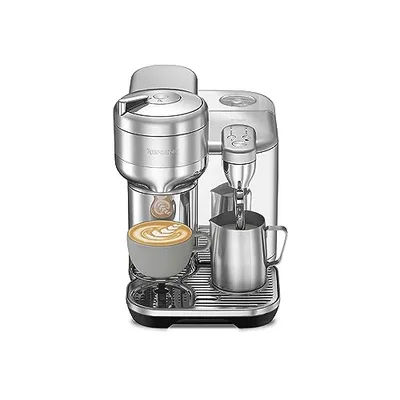
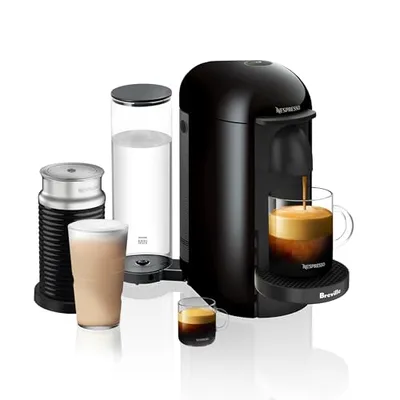
Extraction by centrifusion, not pressure — the capsule's barcode sets volume, speed and temperature, and there is nothing for you to adjust.
- Capsule
Updated · Capsule
Capsule convenience with milk you can actually pour latte art on, 6.7 in wide.
Computed from published specifications — not a taste test. We do not brew or physically test machines.

Prices are the manufacturer's published list price plus any snapshots we have tracked; confirm on the retailer's page before buying. As an Amazon Associate we earn from qualifying purchases — this never affects rankings, which are computed from specifications.
The honest read: the Nespresso Creatista Plus suits you if you want coffee with no decisions and no clean-up beyond a capsule bin, and if milk drinks are a daily routine you would rather not perform by hand, and if counter width is tight — it needs 6.7 inches.
It is the wrong machine if you care what each drink costs or want to choose the beans, or if Nespresso rates it for one or two drinks a day, so a busy household will find it limiting. None of that is a defect — it is what Nespresso chose to build, and choosing against it is how you avoid an expensive mismatch.
The decisive variable is time, not money. About thirty seconds, start to finish, and no decisions inside it. Match that to a real weekday rather than an ideal weekend and the rest of the choice gets much easier.
Nespresso advertises 19 bar. That figure describes the pump's maximum output against a closed outlet, not the pressure at the coffee — espresso extracts at roughly 9 bar, and the machine regulates down to about that. A capsule machine advertising 19 bar and a portafilter machine advertising 9 bar are doing the same thing to the coffee.
The number that actually constrains this machine is not pressure at all. It is the capsule: the dose, the grind, the tamp and the roast were fixed in a factory, and none of them is adjustable by you. That buys total repeatability — every drink is the same drink — and it costs you every lever an espresso machine normally offers.
It also sets the running cost. A capsule typically costs 70 cents to a dollar; the same amount of coffee from whole beans costs around a third of that. Over a few years that difference exceeds the price of the machine, which is the calculation worth doing before buying into any pod system.
Nespresso does not publish the heating system for this model, which is the specification that most determines temperature stability.
Nespresso does not state whether temperature is PID-controlled.
A bare steam wand puts the air and the texture in your hands. Introduce air for two or three seconds, then submerge the tip and let the milk roll — that second phase is what breaks the bubbles down into microfoam.
Texturing is automatic rather than manual, so the machine measures temperature and stops itself.
Because the machine decides when to stop, the temperature and texture are consistent in a way hand-steaming takes weeks to match. The corresponding loss is that you cannot adjust mid-pour, and plant milks — which need less air and a lower ceiling than dairy — depend on whether the machine publishes a setting for them.
It measures 6.7 in wide, 12.2 in deep, 16.1 in tall, which is narrow enough for most apartment counters.
The 1.5 litre tank is roughly 8 drinks between refills at typical volumes.
We do not rate noise, because nobody publishes a figure to rate. What is knowable is the shape of it: a vibratory pump, which buzzes for the 25 to 30 seconds of a shot.
Electrically it is 120V, 1500 W — a standard US outlet, though it is worth not sharing a circuit with a kettle or toaster you use at the same moment.
The milk system needs rinsing after every session — automatic milk hardware sours if that is skipped, and it is a hygiene issue rather than a taste one.
Descaling is on its own schedule — every one to three months depending on your water hardness, using Nespresso's approved solution rather than vinegar.
The failure modes are worth naming because they present as different problems. Coffee oils left in the brew path go rancid and produce a stale bitterness that survives changing beans — people blame the coffee. Scale narrows the water path and shows up as shots running slower at an unchanged grind — people blame the grinder. Both are cleaning, on two schedules, with two products: detergent for oils, acid for scale, and neither substitutes for the other.
A capsule machine is a sealed consumer appliance: there is no group, no gasket and no user-serviceable brew path, so a failed pump or thermoblock is a replacement rather than a repair.
Capsule machines are sealed consumer appliances: there is no group, no gasket and no user-serviceable brew path. Maintenance is descaling and rinsing only, and a failed pump or thermoblock is generally a replacement rather than a repair.
The manufacturer does not state a US price for this model. Rather than substitute a street price we have not verified, we leave the total open.
The running costs are the same as any machine of this type: beans dominate, then descaler, filters and electricity.
The Nespresso Creatista Plus is a coherent machine with one main compromise: that the capsule fixes every variable and the running cost is several times higher per drink. Whether that matters is a question about you rather than about the machine.
If it is a problem, the Breville Barista Express ($700) is the alternative worth reading next.
Read the score as what it is: a percentile against machines of the same kind, computed from published specifications. It measures specification potential rather than cup quality, and a machine can score modestly against its cohort while being exactly right for one buyer.
Everything above is derived from Nespresso's published specification and our scoring methodology. We have not brewed with this machine and make no claim about how it tastes.
Chosen from this machine's own specification — not a generic bundle. The Nespresso Creatista Plus needs these because of what it does and does not include.
Scale, not use, is what ends most espresso machines. Use the manufacturer-approved solution, never vinegar.
Automatic milk hardware sours without a cleaning cycle after each session.
The one maintenance job a capsule machine still needs.
As an Amazon Associate we earn from qualifying purchases. These are category searches rather than specific product endorsements — we have not tested accessories any more than we have tested machines.
Transcribed from Nespresso's official spec sheet. An em dash means the manufacturer does not publish that figure — we never estimate one in.
| Spec | Value |
|---|---|
| Machine type | Capsule |
| Automation level | Capsule |
| Status | Current model |
| Release year | — |
| Suggested daily volume | 1-2 drinks/day |
| Spec | Value |
|---|---|
| Heating system | — |
| Heating circuits | — |
| Boiler material | — |
| PID temperature control | — |
| Heat-up time | — |
| Pump pressure (marketing) | 19 bar |
| Brew pressure at the puck | ~9 bar — the figure that matters |
| Pump type | — |
| Pressure profiling | — |
| Spec | Value |
|---|---|
| Built-in grinder | No |
| Burr type | — |
| Grind settings | — |
| Bean hopper | — |
| Spec | Value |
|---|---|
| Portafilter size | — |
| Portafilter type | — |
| Group type | capsule |
| Milk system | Steam wand |
| Automatic milk texturing | Yes |
| Spec | Value |
|---|---|
| Water tank | 1.5 L |
| Dimensions | 6.7 × 12.2 × 16.1 in (W×D×H) |
| Width | 6.7 in |
| Weight | 11 lb (5.2 kg) |
| Voltage | 120V |
| Wattage | 1500 W |
| Plumbable | No |
| Made in | — |
| Spec | Value |
|---|---|
| Descaling required | Yes |
| Automatic rinse / self-clean | — |
| Removable brew group | — |
| Backflushable (3-way valve) | No |
Consumables are estimates for roughly two drinks a day; electricity is computed from the manufacturer's published wattage. Full two-year calculator · how we calculate this
Percentile-ranked against other capsule machines — machines bought for the same reasons, not every machine of the same type. A component with no published inputs is dropped, not scored zero.
Same machine type, similar price, ordered by score.

Extraction by centrifusion, not pressure — the capsule's barcode sets volume, speed and temperature, and there is nothing for you to adjust.
Published side-by-side comparisons involving this machine.
Position on each list this machine qualifies for. Each list ranks its own members, so these placings say more than any single score does.
We publish Nespresso's error codes and display messages transcribed from Nespresso's own manuals, with what each one means and the user-serviceable fix.
Every specification on this page was transcribed from Nespresso's official product page for the Nespresso Creatista Plus. Figures the manufacturer does not publish are stored as null and rendered as an em dash. Scores are computed by our published methodology and are not a taste test.