68/100
Semi-automatic
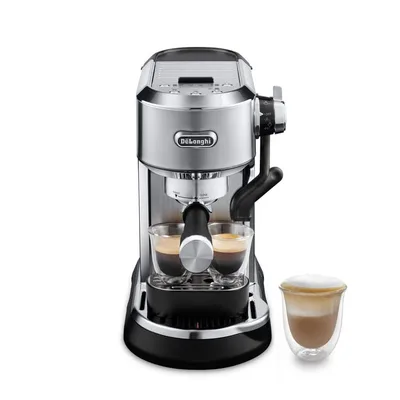
A Dedica with an automatic steam wand — milk texturing without the learning curve, still in a compact body.
- Semi-automatic
- Steam wand
Pump:15 bar(marketing)·Brews at:~9 bar(what the coffee actually sees)
Updated · Semi-automatic
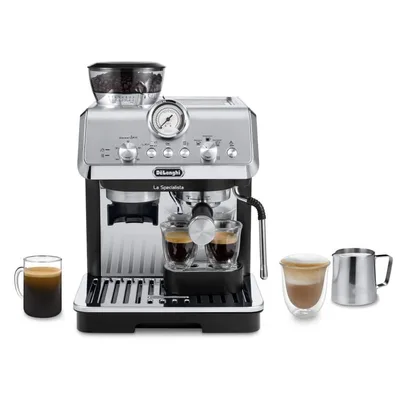
One appliance instead of two, 11.2 in wide, $700.
Computed from published specifications — not a taste test. We do not brew or physically test machines.
Prices are the manufacturer's published list price plus any snapshots we have tracked; confirm on the retailer's page before buying. As an Amazon Associate we earn from qualifying purchases — this never affects rankings, which are computed from specifications.
The bar number on the box is the pump's maximum, not the brewing pressure. An over-pressure valve regulates it down to roughly 9 bar at the puck. Why the box number doesn't matter →
Put plainly: the De'Longhi La Specialista Arte suits you if you want to learn espresso without buying and housing a second appliance, and if you are willing to spend a few weeks learning to texture milk on a real wand.
It is the wrong machine if you already own a burr grinder you rate, in which case you are paying twice for one. None of that is a defect — it is what De'Longhi chose to build, and choosing against it is how you avoid an expensive mismatch.
The decisive variable is time, not money. Four or five minutes from cold once you know the machine: grind, dose, tamp, pull, texture, wipe down. Match that to a real weekday rather than an ideal weekend and the rest of the choice gets much easier.
15 bar is the number printed largest on the box, and it is the least useful specification on the machine. It describes the maximum pressure the pump can generate against a closed outlet.
Espresso extracts at roughly 9 bar at the coffee. Every well-designed machine, including this one, regulates the pump down to about that using an over-pressure valve that bleeds the excess back to the tank. A machine advertising 15 bar and one advertising 9 bar can pull an identical shot — and a machine that genuinely delivered 15 bar to the puck would make worse espresso, because excessive pressure compacts the bed and promotes channelling.
The specifications that matter more are the ones further down the sheet: heating system, temperature control and milk hardware.
We publish both numbers on every machine for this reason. The bar rating is what the manufacturer chose to advertise; ~9 bar is what the coffee experiences.
Rather than keeping a vessel at temperature, a thermoblock heats water as it passes through. Fast to start, and more dependent on flow rate to hold a steady temperature.
De'Longhi does not state whether temperature is PID-controlled.
Grind is adjusted across 8 settings. Dialling in means making small corrections inside a narrow band, so the number of usable steps matters more than the headline count — with 8 you have room to move without landing between two settings, one too fast and one too slow.
A bare steam wand puts the air and the texture in your hands. Introduce air for two or three seconds, then submerge the tip and let the milk roll — that second phase is what breaks the bubbles down into microfoam.
Whatever the hardware, the target is the same: stop between 140 and 150°F. Past roughly 160°F the proteins denature, the sweetness goes and the foam collapses — and milk cannot be re-textured once taken there.
It measures 11.2 in wide, 14.4 in deep, 15.9 in tall.
We do not rate noise, because nobody publishes a figure to rate. What is knowable is the shape of it: a vibratory pump, which buzzes for the 25 to 30 seconds of a shot, preceded by a few seconds of grinding.
Electrically it is 120V, 1300 W — a standard US outlet, though it is worth not sharing a circuit with a kettle or toaster you use at the same moment.
There is no three-way valve, so this machine cannot be backflushed. Cleaning the brew path means removing and soaking the shower screen and scrubbing the group instead.
Clean the wand while it is still hot. A quick purge and wipe takes seconds; a tip that has dried takes a soak and a pin.
Descaling is on its own schedule — every one to three months depending on your water hardness, using De'Longhi's approved solution rather than vinegar. Machines with narrow thermoblock passages are the least tolerant of a missed interval, because scale narrows the channel until it blocks.
Neglect announces itself in two disguises. A bitter, stale note that follows you across different bags is almost always oils in the group rather than the beans. A shot that has crept slower over months at the same setting is almost always scale rather than the grinder. Detergent fixes the first, an acid descaler the second.
Treat the group gasket as a consumable: used daily it hardens within roughly a year, and the tell is the portafilter handle sitting further round than it used to when locked in. A few dollars and ten minutes, and it stops a slow leak turning into a diagnosis.
The automatic range uses a removable brew group that the owner rinses under the tap — the single biggest serviceability advantage over sealed super-autos. Descaler and AquaClean-style filters are stocked first-party.
At $700 the machine is the smaller half of the first year. Beans at roughly $260, descaler and filters at about $70, and electricity at around $32 computed from the published 1300 W rating bring the first year to roughly $1,062.
For context, the median published price across machines of this type in our database is $600, so this sits above the middle of its category.
The De'Longhi La Specialista Arte is a coherent machine with one main compromise: price rather than capability. Whether that matters is a question about you rather than about the machine.
If it is a problem, the Gaggia Anima Prestige ($849) is the alternative worth reading next.
Scores here are relative and computed, never awarded. A modest figure against a cohort of far more expensive machines is a statement about the cohort as much as about this machine.
Everything above is derived from De'Longhi's published specification and our scoring methodology. We have not brewed with this machine and make no claim about how it tastes.
Chosen from this machine's own specification — not a generic bundle. The De'Longhi La Specialista Arte needs these because of what it does and does not include.
Scale, not use, is what ends most espresso machines. Use the manufacturer-approved solution, never vinegar.
350 ml for one drink, 600 ml for two — too large a jug prevents the vortex that makes microfoam.
As an Amazon Associate we earn from qualifying purchases. These are category searches rather than specific product endorsements — we have not tested accessories any more than we have tested machines.
Transcribed from De'Longhi's official spec sheet. An em dash means the manufacturer does not publish that figure — we never estimate one in.
| Spec | Value |
|---|---|
| Machine type | Semi-automatic |
| Automation level | Semi-automatic |
| Status | Current model |
| Release year | — |
| Suggested daily volume | 2-5 drinks/day |
| Spec | Value |
|---|---|
| Heating system | Thermoblock |
| Heating circuits | 1 |
| Boiler material | — |
| PID temperature control | — |
| Heat-up time | — |
| Pump pressure (marketing) | 15 bar |
| Brew pressure at the puck | ~9 bar — the figure that matters |
| Pump type | — |
| Pressure profiling | — |
| Spec | Value |
|---|---|
| Built-in grinder | Yes |
| Burr type | conical burr |
| Grind settings | 8 |
| Bean hopper | — |
| Spec | Value |
|---|---|
| Portafilter size | — |
| Portafilter type | — |
| Group type | — |
| Milk system | Steam wand |
| Automatic milk texturing | No |
| Spec | Value |
|---|---|
| Water tank | — |
| Dimensions | 11.2 × 14.4 × 15.9 in (W×D×H) |
| Width | 11.2 in |
| Weight | 29 lb (13 kg) |
| Voltage | 120V |
| Wattage | 1300 W |
| Plumbable | No |
| Made in | — |
| Spec | Value |
|---|---|
| Descaling required | Yes |
| Automatic rinse / self-clean | — |
| Removable brew group | — |
| Backflushable (3-way valve) | No |
Consumables are estimates for roughly two drinks a day; electricity is computed from the manufacturer's published wattage. Full two-year calculator · how we calculate this
Percentile-ranked against other all in one semi-automatic machines — machines bought for the same reasons, not every machine of the same type. A component with no published inputs is dropped, not scored zero.
Same machine type, similar price, ordered by score.
A Dedica with an automatic steam wand — milk texturing without the learning curve, still in a compact body.
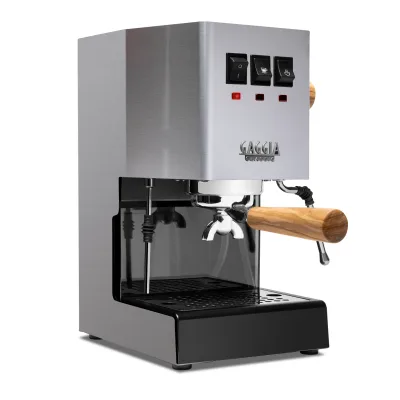
A lead-free brass boiler and a 58 mm commercial portafilter, with the over-pressure valve set to 9 bar at the puck from the factory.
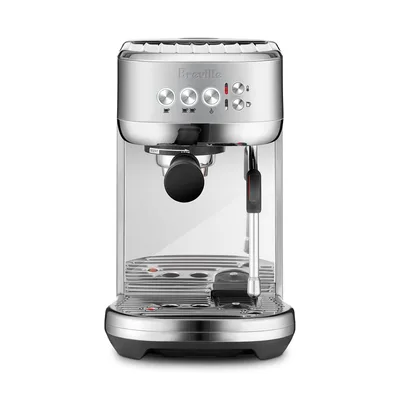
A Bambino with the milk problem solved: the wand textures automatically across three temperatures and three foam levels.
Position on each list this machine qualifies for. Each list ranks its own members, so these placings say more than any single score does.
We publish De'Longhi's error codes and display messages transcribed from De'Longhi's own manuals, with what each one means and the user-serviceable fix.
Every specification on this page was transcribed from De'Longhi's official product page for the De'Longhi La Specialista Arte. Figures the manufacturer does not publish are stored as null and rendered as an em dash. Scores are computed by our published methodology and are not a taste test.