Breville Oracle Jet
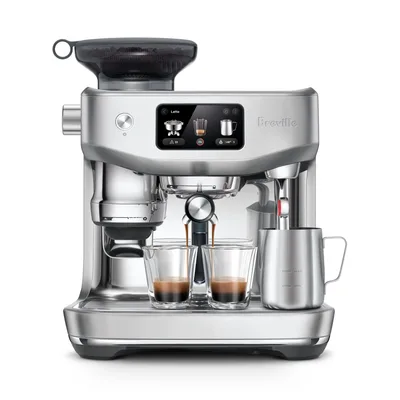
$2,00058 mm portafilter, 45 grind settings and Auto MilQ automatic texturing with alternative-milk profiles in one touchscreen machine.
- Semi-automatic
- Grinder · 45 settings
- 58mm portafilter
- Steam wand
Updated · Semi-automatic
Café-style simultaneous brewing and steaming from one boiler, 9 in wide.
Computed from published specifications — not a taste test. We do not brew or physically test machines.

Prices are the manufacturer's published list price plus any snapshots we have tracked; confirm on the retailer's page before buying. As an Amazon Associate we earn from qualifying purchases — this never affects rankings, which are computed from specifications.
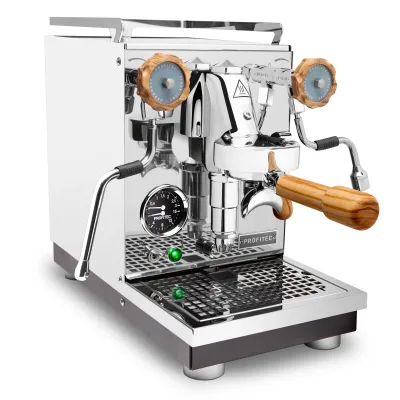
Put plainly: the Profitec PRO 400 suits you if you already own a burr grinder, or have budgeted for one alongside this machine, and if you are willing to spend a few weeks learning to texture milk on a real wand, and if Profitec rates it for five to fifteen drinks a day.
It is the wrong machine if the grinder is not in the budget — this machine cannot reach its ceiling on pre-ground coffee, or if you need to move the machine, because it weighs 47 lb. None of that is a defect — it is what Profitec chose to build, and choosing against it is how you avoid an expensive mismatch.
The question underneath all of this is how long you want the process to take. Four or five minutes plus whatever your separate grinder adds, and a genuine learning period before that becomes reliable. That is the difference people actually live with, and it is worth answering honestly rather than aspirationally — a machine bought for the person you intend to become tends to go unused by the person making coffee on a Tuesday.
The specification that separates the Profitec PRO 400 from the machines below it is the portafilter: 58 mm, the commercial standard, non-pressurized. That is not a performance number, which is why marketing rarely leads with it, and it is probably the most consequential line on the spec sheet.
Because 58 mm is what commercial machines use, the accessory market for it is enormous and permanent. That is a different proposition from a proprietary size, where the parts exist while the manufacturer chooses to stock them.
The second thing you are buying is thermal mass. Profitec specifies a heat exchanger in stainless, and metal that holds heat is what keeps temperature stable while water is passing through the puck. It is also why this machine is slow to warm up and heavy — the same property, seen from two directions.
Profitec publishes no pump pressure figure, which is the least informative specification on any espresso machine anyway — extraction happens at roughly 9 bar regardless.
Brew water passes through the steam boiler rather than sitting in its own, so it arrives hot on demand. That is how a single-boiler machine steams continuously without a second heater.
Temperature is held by a PID controller, which measures continuously and modulates the element to hold the number you set — the feature most likely to make two consecutive shots behave the same.
It offers basic preinfusion, which wets the puck before full pressure arrives and reduces channelling on an uneven bed.
A three-way solenoid valve releases pressure at the end of the shot — which is why the puck knocks out dry, and why the group can be backflushed properly rather than just wiped.
Non-pressurized baskets put the burden of resistance on the coffee, which is why they reward a good grinder and punish a poor one rather than smoothing over the difference.
Everything above is capped by a component this machine does not include. Grind quality sets the ceiling on extraction, so a modest machine with a good grinder beats this one fed pre-ground coffee — which is why the grinder belongs in the purchase budget rather than a later plan.
A commercial wand offers no assistance and no ceiling. Air goes in when you let it in, and the texture is whatever your technique produces — which is the point for anyone who wants to pour latte art.
There is no waiting for steam between drinks — the boiler arrangement keeps it available while you brew.
Aim to finish around 150°F. Above that the proteins that hold the foam together break down, which is why scalded milk froths into large bubbles and never recovers.
It measures 9 in wide, 17.6 in deep, 14.6 in tall, which is narrow enough for most apartment counters.
The 2.8 litre tank is roughly 14 drinks between refills at typical volumes.
At 47 lb it claims its space permanently; this is not a machine you slide aside.
We do not rate noise, because nobody publishes a figure to rate. What is knowable is the shape of it: a vibratory pump, which buzzes for the 25 to 30 seconds of a shot.
Electrically it is 115V, 1500 W — a standard US outlet, though it is worth not sharing a circuit with a kettle or toaster you use at the same moment.
Profitec states it is made in Germany.
Fit a blind basket and the machine cleans its own brew path — water weekly, detergent about monthly. It is the difference between a group that stays neutral and one that seasons every shot with old oil.
Wipe and purge the wand every time rather than at the end of a session — a blocked tip is the single most common steam fault and it is entirely preventable.
Descaling is on its own schedule — every one to three months depending on your water hardness, using Profitec's approved solution rather than vinegar.
Neglect announces itself in two disguises. A bitter, stale note that follows you across different bags is almost always oils in the group rather than the beans. A shot that has crept slower over months at the same setting is almost always scale rather than the grinder. Detergent fixes the first, an acid descaler the second.
The commercial group size means the parts you will actually replace — gasket, screen, baskets — are available from multiple suppliers indefinitely.
A stainless boiler can be descaled and serviced rather than replaced, which is most of why machines built this way are kept running for decades.
Budget for a gasket roughly annually. It is the cheapest maintenance on the machine and the one most often mistaken for a fault, because a perished gasket looks exactly like a leak.
Stainless boilers, standard commercial group hardware and an adjustable expansion valve mean brew pressure can be set and wear parts replaced without proprietary tooling.
The manufacturer does not state a US price for this model. Rather than substitute a street price we have not verified, we leave the total open.
The running costs are the same as any machine of this type: beans dominate, then descaler, filters and electricity.
The Profitec PRO 400 is a coherent machine with one main compromise: that it arrives without the grinder that determines most of what it can do. Whether that matters is a question about you rather than about the machine.
If it is a problem, the De'Longhi Dinamica Plus ($1,700) is the alternative worth reading next.
The number is a ranking within a cohort, not a grade. It answers "how does this compare to machines built for the same job" and says nothing about what the coffee tastes like, which no specification can.
Everything above is derived from Profitec's published specification and our scoring methodology. We have not brewed with this machine and make no claim about how it tastes.
Chosen from this machine's own specification — not a generic bundle. The Profitec PRO 400 needs these because of what it does and does not include.
Not optional — pre-ground coffee cannot be adjusted to the fineness espresso needs.
Level, repeatable tamping is what prevents channelling; 58 mm is this machine's basket size.
Dosing and stopping by weight removes the two biggest sources of shot-to-shot variation.
Scale, not use, is what ends most espresso machines. Use the manufacturer-approved solution, never vinegar.
This machine has a three-way valve, so the group can be cleaned properly rather than wiped.
As an Amazon Associate we earn from qualifying purchases. These are category searches rather than specific product endorsements — we have not tested accessories any more than we have tested machines.
Transcribed from Profitec's official spec sheet. An em dash means the manufacturer does not publish that figure — we never estimate one in.
| Spec | Value |
|---|---|
| Machine type | Semi-automatic |
| Automation level | Semi-automatic |
| Status | Current model |
| Release year | — |
| Suggested daily volume | 5-15 drinks/day |
| Spec | Value |
|---|---|
| Heating system | Heat exchanger |
| Heating circuits | 1 |
| Boiler material | stainless |
| PID temperature control | Yes |
| Heat-up time | — |
| Pump pressure (marketing) | — |
| Brew pressure at the puck | ~9 bar — the figure that matters |
| Pump type | vibratory |
| Pressure profiling | Pre-infusion |
| Spec | Value |
|---|---|
| Built-in grinder | No |
| Burr type | — |
| Grind settings | — |
| Bean hopper | — |
| Spec | Value |
|---|---|
| Portafilter size | 58 mm |
| Portafilter type | Non-pressurized |
| Group type | commercial-58 |
| Milk system | Commercial-style steam wand |
| Automatic milk texturing | No |
| Spec | Value |
|---|---|
| Water tank | 2.8 L |
| Dimensions | 9 × 17.6 × 14.6 in (W×D×H) |
| Width | 9 in |
| Weight | 47 lb (21.5 kg) |
| Voltage | 115V |
| Wattage | 1500 W |
| Plumbable | No |
| Made in | Germany |
| Spec | Value |
|---|---|
| Descaling required | Yes |
| Automatic rinse / self-clean | — |
| Removable brew group | — |
| Backflushable (3-way valve) | Yes |
Consumables are estimates for roughly two drinks a day; electricity is computed from the manufacturer's published wattage. Full two-year calculator · how we calculate this
Percentile-ranked against other prosumer semi-automatic machines — machines bought for the same reasons, not every machine of the same type. A component with no published inputs is dropped, not scored zero.
Same machine type, similar price, ordered by score.

58 mm portafilter, 45 grind settings and Auto MilQ automatic texturing with alternative-milk profiles in one touchscreen machine.

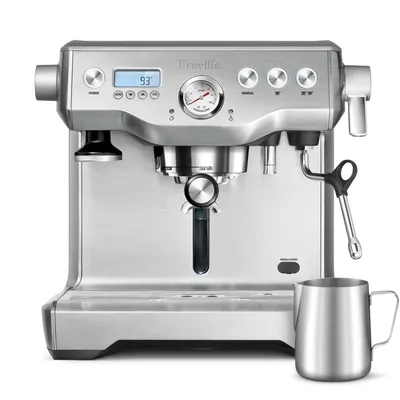
Stainless dual boilers, PID and a 58 mm commercial portafilter — the point where Breville stops using its own 54 mm standard.

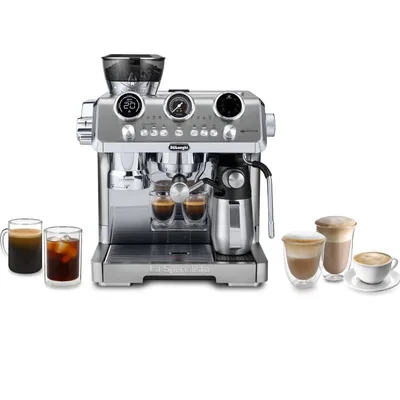
The most capable machine in De'Longhi's portafilter range: dual heating, 15 grind settings and cold extraction.
Published side-by-side comparisons involving this machine.
Position on each list this machine qualifies for. Each list ranks its own members, so these placings say more than any single score does.
We publish Profitec's error codes and display messages transcribed from Profitec's own manuals, with what each one means and the user-serviceable fix.
Every specification on this page was transcribed from Profitec's official product page for the Profitec PRO 400. Figures the manufacturer does not publish are stored as null and rendered as an em dash. Scores are computed by our published methodology and are not a taste test.