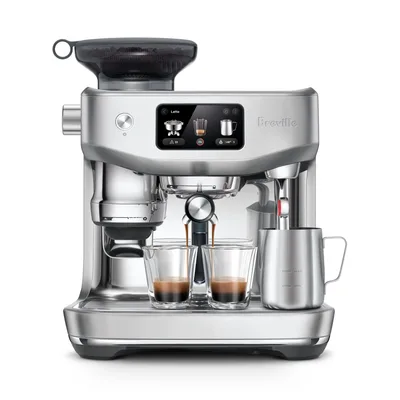
Breville Oracle Jet
$2,00058 mm portafilter, 45 grind settings and Auto MilQ automatic texturing with alternative-milk profiles in one touchscreen machine.
- Semi-automatic
- Grinder · 45 settings
- 58mm portafilter
- Steam wand
Updated · Semi-automatic
Café-style simultaneous brewing and steaming from one boiler, 10.8 in wide.
Computed from published specifications — not a taste test. We do not brew or physically test machines.

Prices are the manufacturer's published list price plus any snapshots we have tracked; confirm on the retailer's page before buying. As an Amazon Associate we earn from qualifying purchases — this never affects rankings, which are computed from specifications.
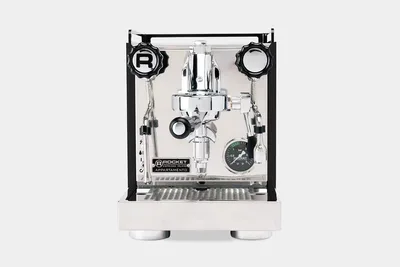
Put plainly: the Rocket Espresso Appartamento suits you if you already own a burr grinder, or have budgeted for one alongside this machine, and if you are willing to spend a few weeks learning to texture milk on a real wand, and if Rocket Espresso rates it for five to fifteen drinks a day.
It is the wrong machine if the grinder is not in the budget — this machine cannot reach its ceiling on pre-ground coffee, or if you need to move the machine, because it weighs 44 lb. None of that is a defect — it is what Rocket Espresso chose to build, and choosing against it is how you avoid an expensive mismatch.
Everything else follows from how much of your morning this should occupy. Four or five minutes plus whatever your separate grinder adds, and a genuine learning period before that becomes reliable. Buyers who answer that honestly stay happy with modest machines; buyers who answer aspirationally end up with capable ones gathering dust.
The specification that separates the Rocket Espresso Appartamento from the machines below it is the portafilter: 58 mm, the commercial standard, non-pressurized. That is not a performance number, which is why marketing rarely leads with it, and it is probably the most consequential line on the spec sheet.
Standardising on 58 mm means the wear parts are commodities rather than proprietary items — which is why machines built this way stay economically repairable for decades.
Rocket Espresso does not publish the boiler material for this model, which is the figure that would tell you most about thermal stability.
Rocket Espresso publishes no pump pressure figure, which is the least informative specification on any espresso machine anyway — extraction happens at roughly 9 bar regardless.
A heat exchanger runs brew water through a pipe inside the steam boiler, heating it in transit. One vessel does both jobs at once — fewer parts than a dual boiler, and no waiting between shot and milk.
Temperature is thermostat-controlled rather than PID-controlled, which means it swings around a setpoint instead of holding it. Owners work with that by timing the shot to the cycle rather than ignoring it.
A three-way solenoid valve releases pressure at the end of the shot — which is why the puck knocks out dry, and why the group can be backflushed properly rather than just wiped.
Because the baskets are single-wall, nothing but the puck stands between the pump and the cup. Get the grind wrong and the shot tells you immediately, which is exactly the feedback a pressurized basket removes.
The limiting component here is not on this spec sheet. Pre-ground coffee is fixed at one fineness chosen for somebody else's equipment, so a separate burr grinder is a requirement rather than an upgrade path.
A commercial-style steam wand gives you complete control over how much air enters the milk and how fast it spins — the two variables that decide whether you get microfoam or foam. Highest ceiling of any milk system, steepest learning curve; expect a few weeks before a flat white pours cleanly.
Steam capacity is continuous rather than intermittent, which is what makes several milk drinks in a row practical.
The ceiling matters more than the floor. Milk held past about 160°F loses its sweetness and its structure permanently, so the skill is knowing when to stop rather than how long to go.
It measures 10.8 in wide, 17.3 in deep, 14.2 in tall.
At 44 lb it claims its space permanently; this is not a machine you slide aside.
Since no manufacturer states a sound level, we rank nothing on it. Mechanically, a vibratory pump is audible throughout the shot.
Electrically it is 1350 W — a standard US outlet, though it is worth not sharing a circuit with a kettle or toaster you use at the same moment.
Rocket Espresso states it is made in Italy.
A blind basket and a monthly detergent cycle keep the brew path clean. Machines without a three-way valve cannot do this at all, and rely on soaking parts instead.
Wipe and purge the wand every time rather than at the end of a session — a blocked tip is the single most common steam fault and it is entirely preventable.
Descaling is on its own schedule — every one to three months depending on your water hardness, using Rocket Espresso's approved solution rather than vinegar.
The failure modes are worth naming because they present as different problems. Coffee oils left in the brew path go rancid and produce a stale bitterness that survives changing beans — people blame the coffee. Scale narrows the water path and shows up as shots running slower at an unchanged grind — people blame the grinder. Both are cleaning, on two schedules, with two products: detergent for oils, acid for scale, and neither substitutes for the other.
Because the group is 58 mm commercial hardware, gaskets, screens, baskets and tampers are standard parts from many suppliers rather than proprietary items from one.
The group gasket is the one part that will certainly need replacing. When the handle starts creeping past its usual position, the rubber has hardened and stopped sealing — which is also the most common cause of water escaping around the portafilter.
Commercial architecture throughout — E61-family groups, standard 58 mm baskets and serviceable boilers. Rocket sells group-head gaskets and wear parts directly.
We cannot give a first-year figure for this machine because its list price is not published. Everything else is knowable; the term that dominates the sum is not.
Whatever it cost you, the running total after that is mostly coffee, with consumables and electricity as minor lines.
The Rocket Espresso Appartamento is a coherent machine with one main compromise: that it arrives without the grinder that determines most of what it can do. Whether that matters is a question about you rather than about the machine.
If it is a problem, the De'Longhi Dinamica Plus ($1,700) is the alternative worth reading next.
Read the score as what it is: a percentile against machines of the same kind, computed from published specifications. It measures specification potential rather than cup quality, and a machine can score modestly against its cohort while being exactly right for one buyer.
Everything above is derived from Rocket Espresso's published specification and our scoring methodology. We have not brewed with this machine and make no claim about how it tastes.
Chosen from this machine's own specification — not a generic bundle. The Rocket Espresso Appartamento needs these because of what it does and does not include.
Not optional — pre-ground coffee cannot be adjusted to the fineness espresso needs.
Level, repeatable tamping is what prevents channelling; 58 mm is this machine's basket size.
Dosing and stopping by weight removes the two biggest sources of shot-to-shot variation.
Scale, not use, is what ends most espresso machines. Use the manufacturer-approved solution, never vinegar.
This machine has a three-way valve, so the group can be cleaned properly rather than wiped.
As an Amazon Associate we earn from qualifying purchases. These are category searches rather than specific product endorsements — we have not tested accessories any more than we have tested machines.
Transcribed from Rocket Espresso's official spec sheet. An em dash means the manufacturer does not publish that figure — we never estimate one in.
| Spec | Value |
|---|---|
| Machine type | Semi-automatic |
| Automation level | Semi-automatic |
| Status | Current model |
| Release year | — |
| Suggested daily volume | 5-15 drinks/day |
| Spec | Value |
|---|---|
| Heating system | Heat exchanger |
| Heating circuits | 1 |
| Boiler material | — |
| PID temperature control | No |
| Heat-up time | — |
| Pump pressure (marketing) | — |
| Brew pressure at the puck | ~9 bar — the figure that matters |
| Pump type | — |
| Pressure profiling | — |
| Spec | Value |
|---|---|
| Built-in grinder | No |
| Burr type | — |
| Grind settings | — |
| Bean hopper | — |
| Spec | Value |
|---|---|
| Portafilter size | 58 mm |
| Portafilter type | Non-pressurized |
| Group type | e61 |
| Milk system | Commercial-style steam wand |
| Automatic milk texturing | No |
| Spec | Value |
|---|---|
| Water tank | — |
| Dimensions | 10.8 × 17.3 × 14.2 in (W×D×H) |
| Width | 10.8 in |
| Weight | 44 lb (20 kg) |
| Voltage | — |
| Wattage | 1350 W |
| Plumbable | No |
| Made in | Italy |
| Spec | Value |
|---|---|
| Descaling required | Yes |
| Automatic rinse / self-clean | — |
| Removable brew group | — |
| Backflushable (3-way valve) | Yes |
Consumables are estimates for roughly two drinks a day; electricity is computed from the manufacturer's published wattage. Full two-year calculator · how we calculate this
Percentile-ranked against other prosumer semi-automatic machines — machines bought for the same reasons, not every machine of the same type. A component with no published inputs is dropped, not scored zero.
Same machine type, similar price, ordered by score.

58 mm portafilter, 45 grind settings and Auto MilQ automatic texturing with alternative-milk profiles in one touchscreen machine.

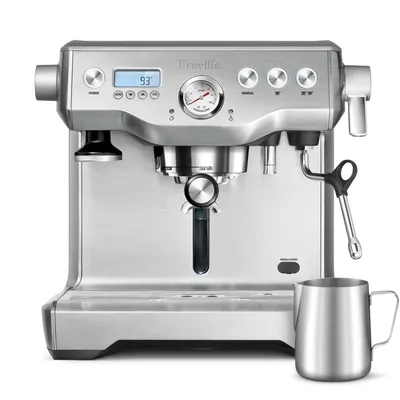
Stainless dual boilers, PID and a 58 mm commercial portafilter — the point where Breville stops using its own 54 mm standard.

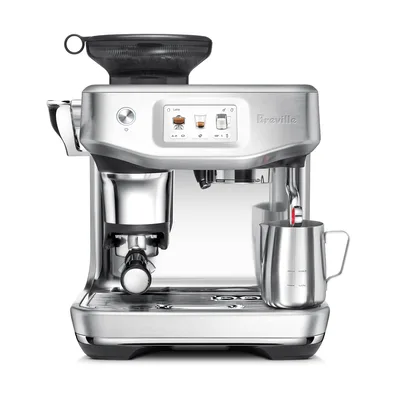
Assisted tamping plus Auto MilQ with dedicated dairy, soy, almond and oat settings across eight texture levels.
Published side-by-side comparisons involving this machine.
Position on each list this machine qualifies for. Each list ranks its own members, so these placings say more than any single score does.
We publish Rocket Espresso's error codes and display messages transcribed from Rocket Espresso's own manuals, with what each one means and the user-serviceable fix.
Every specification on this page was transcribed from Rocket Espresso's official product page for the Rocket Espresso Appartamento. Figures the manufacturer does not publish are stored as null and rendered as an em dash. Scores are computed by our published methodology and are not a taste test.