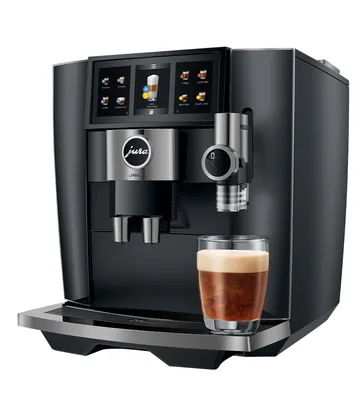
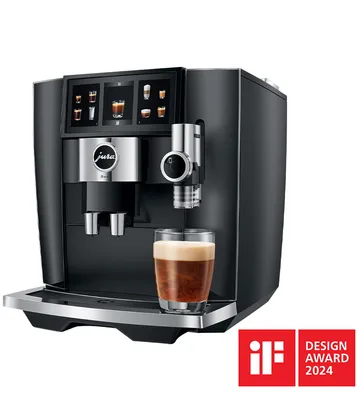
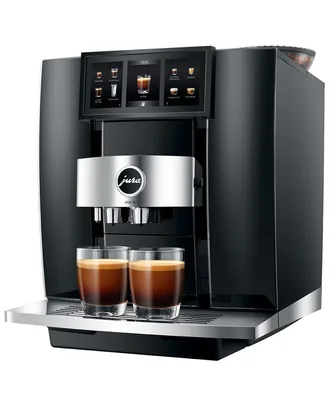
JURA GIGA 10
$5,499Two thermoblocks and two grinders, 35 specialties, 18 kg — this is JURA's office machine wearing a home badge.
- Super-automatic
- Thermoblock
- Grinder built in
- Automatic milk carafe
Updated · Super-automatic
A full milk drink at one button, 10.6 in wide.
Computed from published specifications — not a taste test. We do not brew or physically test machines.
Sold in Europe and the UK since July 2026. JURA has announced no US release, and it is not listed on jura.com's US site. Announced July 27, 2026.
No list price published for this machine in any market we can cite.
We are tracking the US launch. When JURA publishes US pricing and availability, this page gets a US price block and the machine enters our rankings.
There is no Amazon link on this page because the machine is not listed on amazon.com. We do not put a US affiliate tag on a non-US storefront: it would earn nothing and would imply a US purchase path that does not exist.
The honest read: the JURA E10 suits you if you want a finished drink at one button and are happy for the machine to make every decision, and if milk drinks are a daily routine you would rather not perform by hand, and if JURA rates it for five to fifteen drinks a day.
It is the wrong machine if you want to change the dose, the grind or how the shot extracts. None of that is a defect — it is what JURA chose to build, and choosing against it is how you avoid an expensive mismatch.
The question underneath all of this is how long you want the process to take. A minute or so, most of which is the machine working while you do something else. That is the difference people actually live with, and it is worth answering honestly rather than aspirationally — a machine bought for the person you intend to become tends to go unused by the person making coffee on a Tuesday.
The headline on every bean-to-cup machine is one-touch convenience, and it is true as far as it goes: the JURA E10 grinds, doses, tamps, brews and ejects the puck without you seeing any of it, and textures the milk as well.
What "one touch" does not mean is that the machine is doing what a barista does. Dose, grind fineness and extraction are decided internally and are not independently adjustable, so the ceiling is set by JURA rather than by your technique. That is the whole trade: you cannot make it worse, and you cannot make it better.
The 15 bar figure on the box is the pump's maximum, not the brewing pressure. Espresso extracts at roughly 9 bar whatever the pump is rated at, and on a bean-to-cup machine the regulation is internal and not user-adjustable — which is why we describe pressure here as managed rather than quoting a number that implies a choice you do not have.
JURA does not publish the brew group as user-removable, which is the specification that most determines how long a bean-to-cup machine stays serviceable. Cleaning is limited to the machine's own programme.
A thermoblock heats water on demand instead of holding a reservoir hot. That is why it is ready quickly, and why it carries less thermal ballast than a boiler machine when a shot runs long.
JURA does not state whether temperature is PID-controlled.
Grind is adjusted across 7 settings. Dialling in means making small corrections inside a narrow band, so the number of usable steps matters more than the headline count — with 7 you have room to move without landing between two settings, one too fast and one too slow.
An integrated carafe froths and pours automatically at a button, which removes the hardest skill in home espresso entirely. What it cannot do is let you adjust texture mid-pour.
Because the machine decides when to stop, the temperature and texture are consistent in a way hand-steaming takes weeks to match. The corresponding loss is that you cannot adjust mid-pour, and plant milks — which need less air and a lower ceiling than dairy — depend on whether the machine publishes a setting for them.
It measures 10.6 in wide, 17.6 in deep, 13.7 in tall.
The 1.9 litre tank is roughly 10 drinks between refills at typical volumes.
The hopper holds 280 g of beans — about 16 doubles.
Since no manufacturer states a sound level, we rank nothing on it. Mechanically, a vibratory pump is audible throughout the shot.
Electrically it is 230V, 1450 W — a standard US outlet, though it is worth not sharing a circuit with a kettle or toaster you use at the same moment.
JURA states it is made in Portugal.
JURA does not publish the brew group as user-removable, so routine cleaning is the machine's own tablet cycle — run it on schedule, because there is no other access to the brew path.
The milk system needs rinsing after every session — automatic milk hardware sours if that is skipped, and it is a hygiene issue rather than a taste one.
Descaling is on its own schedule — every one to three months depending on your water hardness, using JURA's approved solution rather than vinegar. Machines with narrow thermoblock passages are the least tolerant of a missed interval, because scale narrows the channel until it blocks.
The failure modes are worth naming because they present as different problems. Coffee oils left in the brew path go rancid and produce a stale bitterness that survives changing beans — people blame the coffee. Scale narrows the water path and shows up as shots running slower at an unchanged grind — people blame the grinder. Both are cleaning, on two schedules, with two products: detergent for oils, acid for scale, and neither substitutes for the other.
JURA brewing units are not user-removable; servicing is done through JURA's own network. Hygiene is handled by integrated rinsing, cleaning and descaling programs plus automatic One-Touch milk-system cleaning on most models.
We cannot give a first-year figure for this machine because its list price is not published. Everything else is knowable; the term that dominates the sum is not.
Whatever it cost you, the running total after that is mostly coffee, with consumables and electricity as minor lines.
The JURA E10 is a coherent machine with one main compromise: that nothing about the extraction is adjustable. Whether that matters is a question about you rather than about the machine.
If it is a problem, the Breville Barista Express ($700) is the alternative worth reading next.
The number is a ranking within a cohort, not a grade. It answers "how does this compare to machines built for the same job" and says nothing about what the coffee tastes like, which no specification can.
Everything above is derived from JURA's published specification and our scoring methodology. We have not brewed with this machine and make no claim about how it tastes.
Chosen from this machine's own specification — not a generic bundle. The JURA E10 needs these because of what it does and does not include.
Scale, not use, is what ends most espresso machines. Use the manufacturer-approved solution, never vinegar.
Automatic milk hardware sours without a cleaning cycle after each session.
As an Amazon Associate we earn from qualifying purchases. These are category searches rather than specific product endorsements — we have not tested accessories any more than we have tested machines.
Transcribed from JURA's official spec sheet. An em dash means the manufacturer does not publish that figure — we never estimate one in.
| Spec | Value |
|---|---|
| Machine type | Super-automatic |
| Automation level | Super-automatic |
| Status | Current model |
| Release year | 2026 |
| Suggested daily volume | 5-15 drinks/day |
| Spec | Value |
|---|---|
| Heating system | Thermoblock |
| Heating circuits | 1 |
| Boiler material | — |
| PID temperature control | — |
| Heat-up time | — |
| Pump pressure (marketing) | 15 bar |
| Brew pressure at the puck | ~9 bar — the figure that matters |
| Pump type | vibratory |
| Pressure profiling | — |
| Spec | Value |
|---|---|
| Built-in grinder | Yes |
| Burr type | conical burr |
| Grind settings | 7 |
| Bean hopper | 280 g |
| Spec | Value |
|---|---|
| Portafilter size | — |
| Portafilter type | — |
| Group type | — |
| Milk system | Automatic milk carafe |
| Automatic milk texturing | Yes |
| Spec | Value |
|---|---|
| Water tank | 1.9 L |
| Dimensions | 10.6 × 17.6 × 13.7 in (W×D×H) |
| Width | 10.6 in |
| Weight | 22 lb (10 kg) |
| Voltage | 230V |
| Wattage | 1450 W |
| Plumbable | No |
| Made in | Portugal |
| Spec | Value |
|---|---|
| Descaling required | Yes |
| Automatic rinse / self-clean | Yes |
| Removable brew group | — |
| Backflushable (3-way valve) | No |
The manufacturer does not publish a list price for this model, so we cannot compute a first-year cost without inventing the biggest number in it.
Percentile-ranked against other super-automatic machines — machines bought for the same reasons, not every machine of the same type. A component with no published inputs is dropped, not scored zero.
Same machine type, similar price, ordered by score.

Two thermoblocks and two grinders, 35 specialties, 18 kg — this is JURA's office machine wearing a home badge.

Forty-six specialties — the largest published drinks list in JURA's home range.

Thirty-one specialties including syrup-flavoured milk foam — JURA's answer to the coffee-shop drinks menu.
Published side-by-side comparisons involving this machine.
Position on each list this machine qualifies for. Each list ranks its own members, so these placings say more than any single score does.
We publish JURA's error codes and display messages transcribed from JURA's own manuals, with what each one means and the user-serviceable fix.
Every specification on this page was transcribed from JURA's official product page for the JURA E10. Figures the manufacturer does not publish are stored as null and rendered as an em dash. Scores are computed by our published methodology and are not a taste test.